
Two New Freight Routes from China to Europe as an Alternative to the Suez Canal Bottleneck
Iran War Sparks Interest in New Transport Routes
Ocean freight between China and Europe faces a critical supply chain risk: the Suez Canal bottleneck. Around 12% of total annual trade volume passes through the Suez Canal. And whenever there is a problem in the Suez Canal, supply chains around the world are thrown into disarray.
Since the war in the Gulf, the Red Sea and the Strait of Hormuz have become unsafe, and anyone moving goods between Asia and Europe is looking for ways around them.
Until now, the only solution was the very long detour (approx. 6,000 kilometers) around the entire African continent.
With the Iran war bringing supply chain risks back into focus, the press has reported on promising new alternatives in recent weeks.
- On the one hand, there are plans to make better use of a northern ocean freight route through the Arctic.
- On the other, a new overland route through Central Asia is being expanded.
In this article, you will learn where things currently stand and whether these routes offer a real alternative for your ocean freight from Asia.
What Fits on the Routes Around the Suez Canal
On August 15, 2026, a Chinese container ship left the port of Ningbo-Zhoushan and headed north. It sailed through the Bering Strait and along Russia’s northern coast, with Felixstowe, Rotterdam, Hamburg, and Gdynia on its schedule.
On board were batteries, solar modules, and other energy storage technology. The voyage was advertised with a transit time of 21 days from Ningbo to Felixstowe – roughly half the time a ship needs on the usual route.
A week later, a second container ship departed from Busan in South Korea, also via the Northeast Passage, scheduled to arrive in Rotterdam on September 10 and in Gdańsk on September 16.
A pleasingly short transit time for the route from China to Europe!
At the same time, Kazakhstan is building an overland route between China and Europe that runs across the Caspian Sea, the South Caucasus, and Turkey.
Both developments share the same goal: creating a supply chain alternative to the Suez Canal as a risk factor.
If you source regularly from China, the question arises naturally: Are the new alternative routes through the Arctic and Central Asia an option for your shipments?
The answer depends less on transit time than on a figure that rarely appears in the news reports.
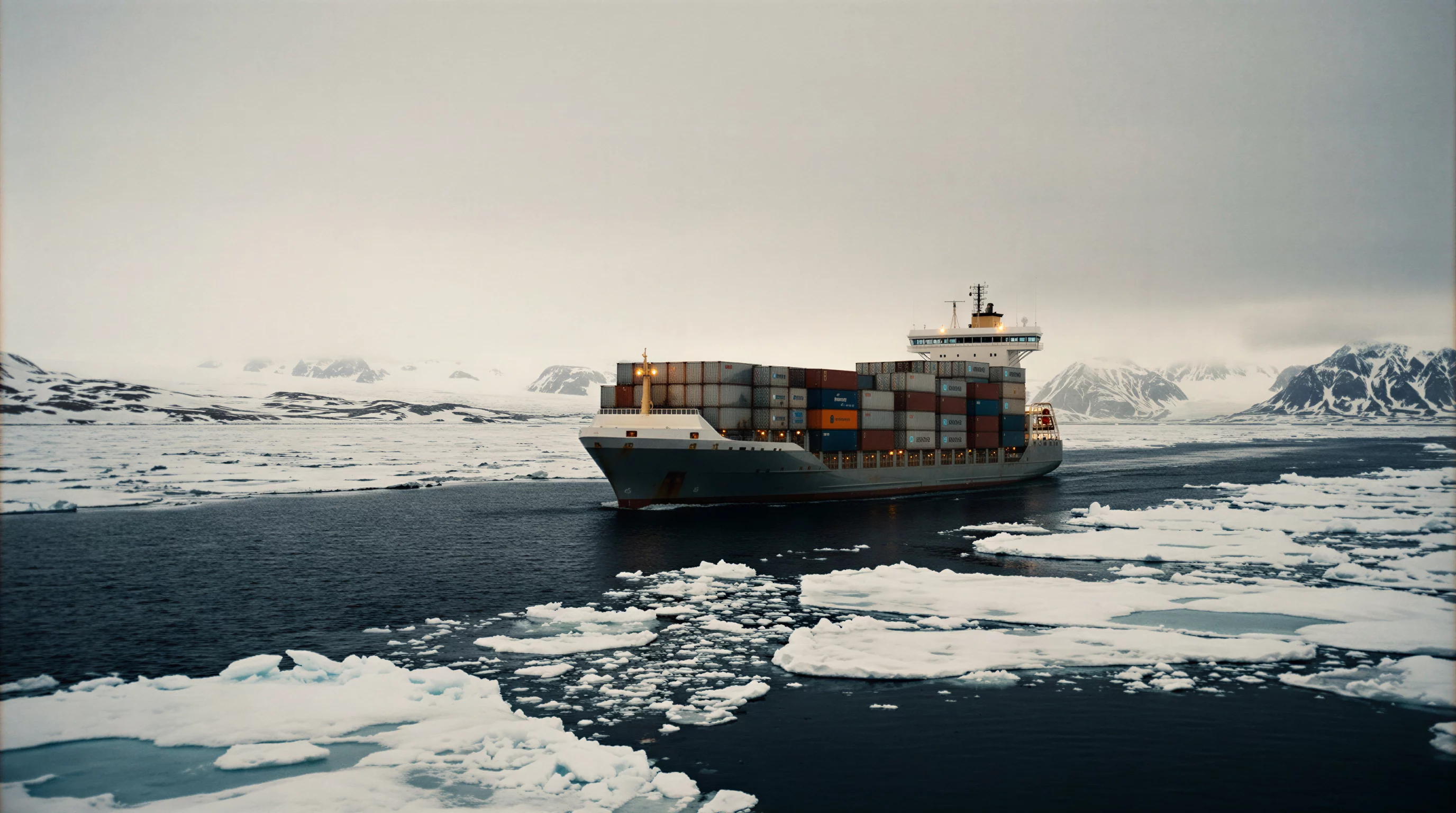
Cargo ship on the Arctic route, AI-generated illustration
One Ship, 1,732 Containers, Eight Voyages Until October
The first ship of this year’s Arctic season has a capacity of 1,732 TEU. A total of eight departures with seven ships have been announced for the 2026 season, spread between mid-August and early October.
Even on generous assumptions – that all eight voyages match the size of the first – the entire season comes to just over 14,000 containers.
For comparison, consider a single ship that docked in Hamburg for the first time in July and is set to operate regularly between Asia and Europe.
It can carry up to 24,212 TEU. A single voyage of this ship therefore moves more than the entire Arctic season with all eight departures combined.
A route that carries less cargo per year than one large container ship is no alternative to the Suez Canal.
Then there is the time window. The Northeast Passage is only navigable without icebreakers during the summer months, and the current season ends in October.
A shipment that finishes production in November cannot take this route. This rules it out for year-round planning, regardless of how well this year’s voyages go.
The Overland Route Across the Caspian Sea Handles Around 77,000 Containers a Year
The Middle Corridor shows a similar order of magnitude – only spread over twelve months instead of ten weeks.
Container traffic on the Trans-Caspian route has grown from around 25,000 TEU in 2021 to nearly 77,000 in 2025. That is strong growth.
Kazakhstan is building a highway of around 800 kilometers between Beineu and Saksaulsk, modernizing border crossings, and expanding its ports on the Caspian Sea.
The EU has earmarked three billion euros from its infrastructure program for this corridor.
Even so, the absolute volume remains too small for now. Nearly 77,000 containers a year equals just over three voyages of the Hamburg ship mentioned above.
The bottleneck lies in the middle of the route. The ports on the Caspian Sea are considered a choke point. The shipping channel at Aktau is currently being deepened so that cargo ships can depart fully loaded at all.
The water level of the Caspian Sea is falling, which is why newly ordered vessels are designed from the outset for a maximum draft of 4.5 meters.
A route that switches from rail to ship and back to rail also carries the risk of delay at every transfer point.
It is considered expensive and complex, and the long-term construction work will not change that in the short


