
Freight Forwarder
India – Germany – India
-
ISO 9001 Certified
-
AEO Certified
-
GDP Certified
-
IATA Cargo Agent
-
Regulated Agent
Transport Between India and Germany
Namaste! Welcome to the world of trade between India and Germany. As your reliable partner for demanding logistics, Excellence Global Logistics opens the doors to the Indian subcontinent for you.
India is a land of contrasts and unlimited opportunities. With its booming economy and over 1.4 billion inhabitants, the subcontinent is a market gaining increasing attention worldwide.
Whether you want to import spices, textiles, pharmaceuticals, or high-tech products to Germany, or export your German quality products to India – we deliver your goods safely to their destination.
Our Transport Solutions for India:
- Air Freight: Lightning-fast from Delhi to Düsseldorf
- Sea Freight: Cost-effective from Mumbai to Hamburg
Master the Challenges of the Indian Market with Us:
- Complex customs regulations?
We navigate you safely through the red tape. - Chaotic road traffic?
Our local partners always find a way. - Extreme weather conditions?
We ensure climate-controlled transport.
With our international network and years of experience, we master every logistical challenge between Berlin and Bangalore. You benefit from our ISO 9001 certification, our AEO authorization, and when needed, GDP-compliant procedures.
Let’s seize the opportunities of the Indian market together. Contact us today for a customized transport solution!
Freight Quote
Let Excellence Global Logistics handle your India-Germany transport operations quickly and seamlessly.
Personal consultation. No-obligation quote.

Growth Market India
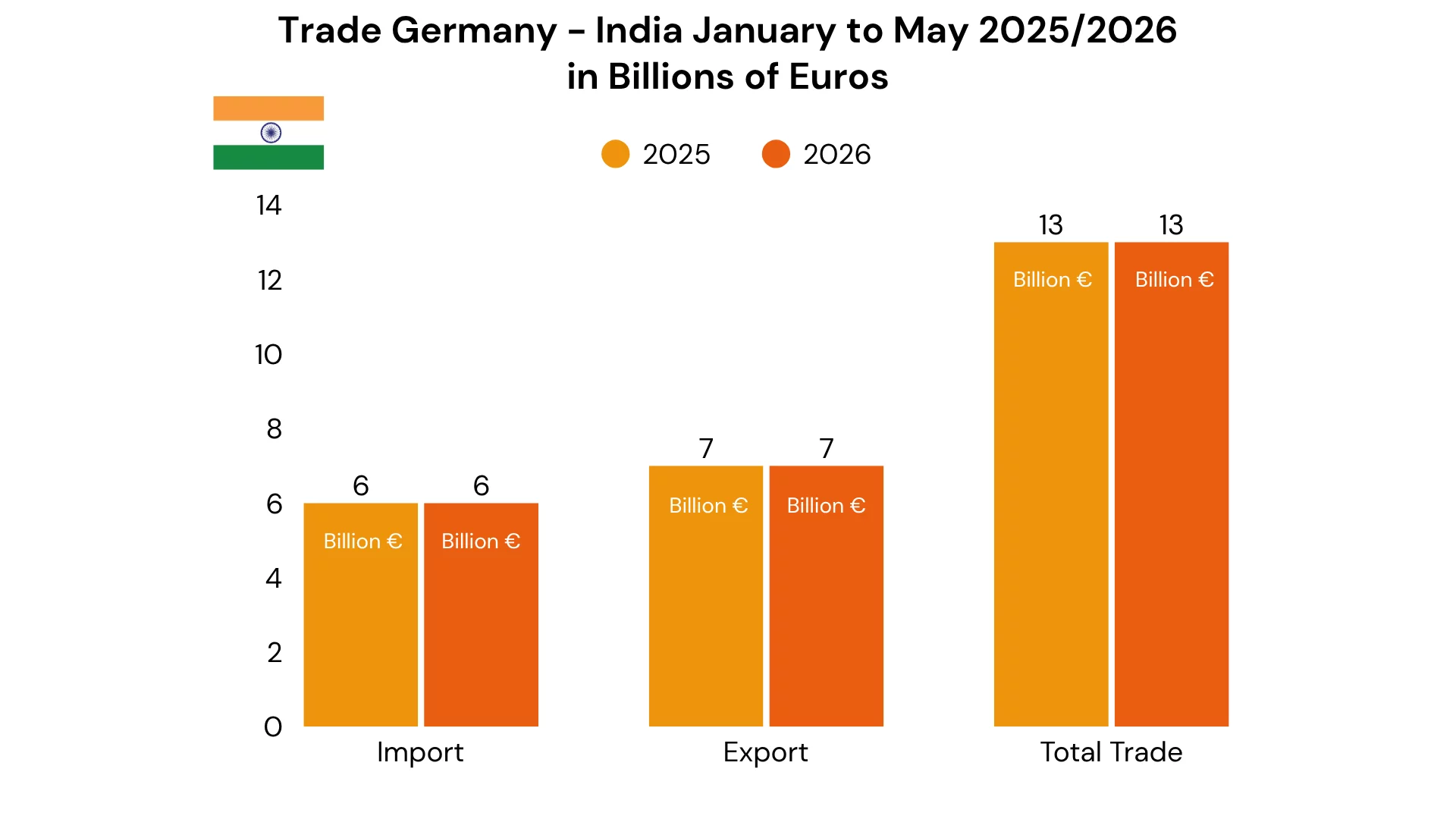
The flow of goods between Germany and India is growing steadily—and with it the demand for reliable transport solutions. Whether in mechanical engineering, chemicals, textiles, or pharmaceuticals, the German-Indian trade partnership is diverse and dynamic.
As your logistics partner, we ensure that your goods become part of this growing trade relationship – on time, safe, and reliable.
FAQ Transport India General
How long does transport between India and Germany take (import and export)?
Short answer: Ocean freight typically takes 4–6 weeks door-to-door, air freight approximately 2–10 days, depending on service level. For a detailed explanation, please visit the respective mode of transport page:
Sea Freight India
Air Freight India
Which transport modes are suitable for goods between Germany and India?
Ocean freight is ideal for large volumes, heavy machinery, or when cost is more important than time. Containers (20’/40′) provide good protection and are suitable for most goods.
Air freight is recommended for urgent, high-value, or sensitive products. It’s more expensive but saves weeks of transit time.
Sea-air solutions combine ocean and air transport (e.g., by ship to the Gulf, then by air to Europe) and often offer a good balance between transit time and cost.
Multimodal means we intelligently combine truck, ocean, and air transport. There is currently no direct rail connection between India and Europe as a standard solution.
Rule of thumb:
- cost-oriented → ocean freight
- time-critical → air freight
- compromise → sea-air
What does transport between India and Germany cost – and which factors determine the price?
Fixed prices are difficult to quote because markets fluctuate. What’s important is understanding what influences the price:
- Transport mode & capacity
Ocean is cheaper than air, but depends on available capacity. - Season & demand
Before holidays like Diwali, demand and prices increase. - Routes & surcharges
Fuel (BAF), security surcharges, port and terminal fees. - Dimensions & weight
In air freight, volumetric weight counts (length × width × height ÷ 6000). This can be more expensive than actual weight. - Service scope
Insurance, export/import customs clearance, delivery, warehousing. - Incoterms®
Define who bears which costs and risks (e.g., EXW, FOB, DAP).
Based on your data (pickup and delivery address, dimensions/weight, type of goods, desired transit time), we prepare a transparent, up-to-date quote.
Which factors influence delivery reliability between India and Germany?
Better planning comes from good preparation. These factors frequently affect transit times:
- Peak seasons & holidays
e.g., Diwali in India. Higher demand means longer waiting times. - Ports & hubs
Congestion at transshipment points (e.g., Jebel Ali, Singapore, Colombo) delays transfers. - Weather
Monsoon can slow down handling operations. - Customs inspections
Additional controls are common for certain product categories. - Documentation
Complete and accurate paperwork expedites processing.
Our approach: book early, plan realistic buffers, actively track shipments, and keep you continuously informed about the status.
Which documents and formalities are required for transport to and from India?
Every shipment requires some basic documents, a transport document depending on the mode of transport, and – depending on the goods – additional certificates. There are also a few organizational matters to clarify. Below you’ll find a clear overview with brief explanations.
1) Basic documents (always required)
Commercial Invoice
The seller’s invoice to the buyer contains sender/consignee, invoice number and date, goods description (clearly understandable), quantity, net weight/gross weight, unit and total price, currency, delivery terms (Incoterms®), payment terms, country of origin.
Packing List
The packing list supplements the invoice with logistical details: number of packages, dimensions, weights, type of packaging, markings/labels, number of pallets if applicable. Helps the freight forwarder, airline/shipping line, and customs with handling.
2) Transport documents (depending on mode of transport)
Ocean freight – Bill of Lading (B/L)
This is the shipping line’s freight document. It proves acceptance of the goods and determines who receives them at destination. Variants:
- Original B/L: Physical originals must be presented/endorsed at destination.
- Telex Release/Express B/L: Electronic release without paper original – faster and simpler when all parties agree.
Practical tip: For letter of credit transactions, banks often require originals.
Air freight – Air Waybill (AWB)
AWB is the term for the airline’s freight document. It is not a negotiable instrument (no original required as with B/L). There are House AWBs (from the forwarder) and Master AWBs (from the airline).
3) Origin and goods certificates (if required)
Certificate of Origin (CoO)
Certifies the country of origin and is required when the buyer/bank or authorities demand it. Currently there are no preferential trade agreements between the EU and India (so no EUR.1).
Industry-specific certificates: Depending on the goods, certificates may be required, such as:
- FSSAI for food imports to India
The Food Safety and Standards Authority of India (FSSAI) is India’s food safety authority. For importing food products, the Indian importer typically needs an FSSAI license/registration and the goods must be labeled according to FSSAI standards (e.g., ingredients, shelf life, veg/non-veg symbol). Without these clearances, customs can halt the shipment. - CDSCO for medical devices/pharmaceuticals in India
The Central Drugs Standard Control Organization (CDSCO) is India’s drug and medical device authority. For pharmaceuticals and many medical devices, CDSCO approvals/registrations and import licenses are required before goods may be imported and sold in India. The goal is to verify safety, quality, and efficacy.
- Quality/conformity certificates as needed (e.g., test reports, standards specifications).
4) Dangerous goods (only if relevant)
Safety Data Sheet (SDS) is provided by the manufacturer/supplier.
Dangerous goods declaration: IMO-DGD for ocean freight or IATA Shipper’s Declaration for air freight. Additionally, UN number, class, packing group, and correct labeling/packaging must be provided.
5) Organization & numbers
EORI number is mandatory for imports and exports in the EU. It is applied for once with customs authorities.
IEC number is the Indian Importer/Exporter Code for companies importing or exporting in India.
ISPM-15 is mandatory for wood packaging. Crates and pallets made of wood must be heat-treated and marked, otherwise rejection is likely.
Power of attorney for customs representative is required in practice. Importers and exporters grant their freight forwarder or customs agent written authorization for customs clearance.
6) Incoterms® – who does what?
The Incoterms® define who handles transport, documents, costs, and risks (e.g., EXW, FOB, CIF, DAP). Example: Under FOB, the seller arranges export and loading onto the ship, while the buyer arranges ocean transport and import. The chosen term therefore determines which party provides which documents.
Freight Quote
Let Excellence Global Logistics handle your India-Germany transport operations quickly and seamlessly.
Personal consultation. No-obligation quote.

