Free Trade Agreement Opens India’s Market to EU Goods
According to the European Commission, European companies could save up to €4 billion a year in duties thanks to the free trade agreement with India. India has almost 1.5 billion people and is the world’s fourth-largest economy. Yet it is only the EU’s ninth-largest trading partner, accounting for just over 2% of EU trade. Two barriers are largely to blame:
- India levies an average tariff of more than 16% on industrial goods. As a result, some European products have so far not reached the Indian market at all.
- How Indian customs will clear a shipment is often impossible to plan reliably, and India requires its own testing for a growing number of products. Screws, electric motors and steel products, for example, can only be imported and sold if they carry an Indian certification mark.
The free trade agreement between the EU and India is intended to make trade easier for companies and to lower these barriers. It will be the largest trade agreement either side has ever concluded, linking a market of around two billion people. Signing is scheduled for December in Brussels, and the agreement is expected to enter into force in the course of 2027. Until then, current tariffs continue to apply. The published texts this article is based on will only become final once the agreement is signed.
Tariffs to be scrapped entirely on 93% of exports
The two sides negotiated for almost twenty years. Talks began in 2007, stalled from 2013 and only got back on track in 2022. The result is far-reaching. Tariffs are to be eliminated entirely on 93% of EU goods exports to India by value and reduced on a further 3.6%. The European Commission expects this to save European companies up to €4 billion a year in duties.
India has never opened up this far to any other trading partner. European companies will therefore be better placed than suppliers from countries that have no agreement with India, and the price gap with Indian manufacturers will narrow too. They will also close the gap on Swiss competitors, as Switzerland and the other EFTA states have had their own agreement with India in force since October 2025.
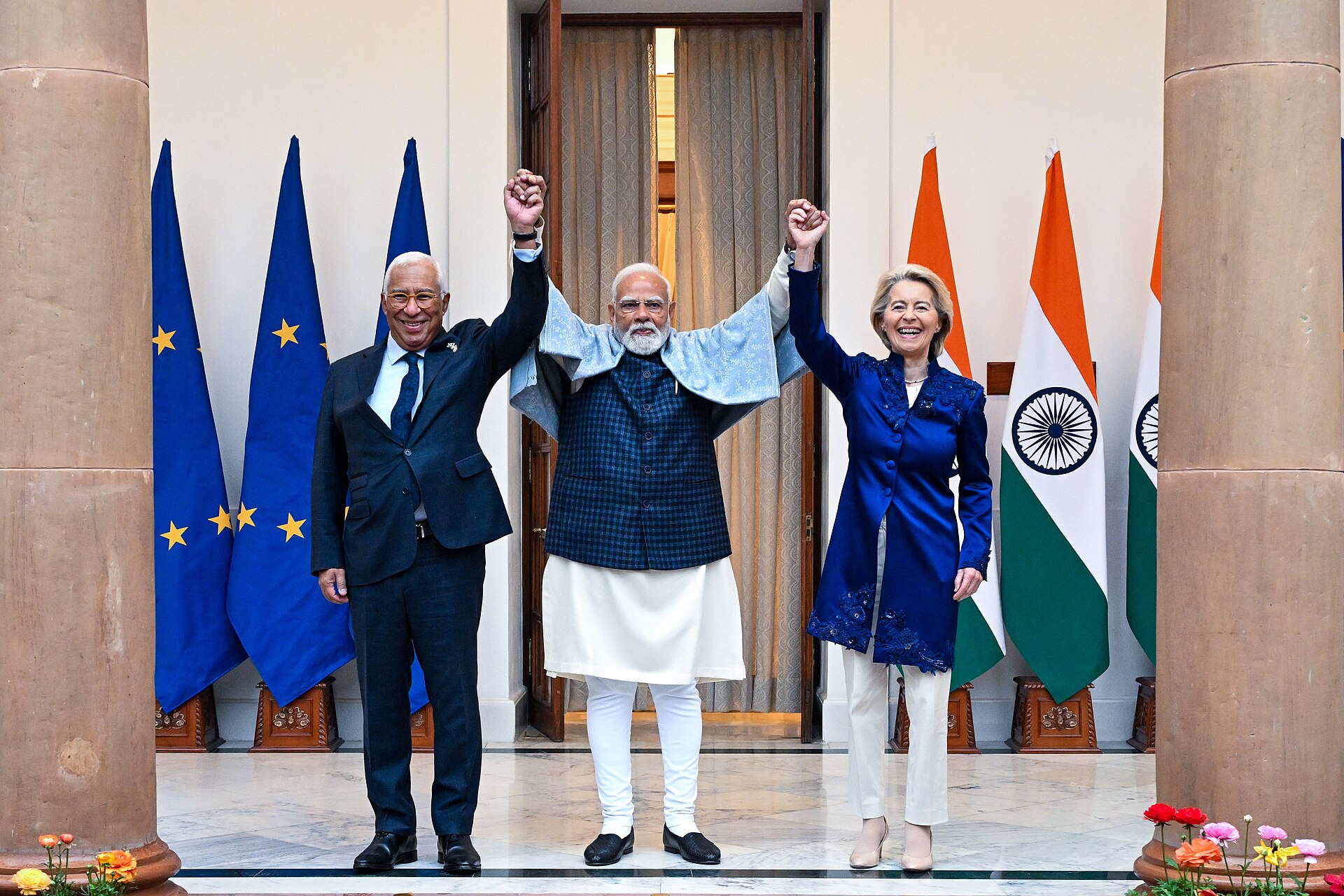
Photo from left to right: António Costa, Narendra Modi, Indian Prime Minister, and Ursula von der Leyen. © European Union, 2026 / Source: European Commission Audiovisual Service / License: CC BY 4.0
Some tariffs go immediately, others only after ten years
The agreement sets the pace of tariff cuts separately for each customs tariff number. You can look up your product’s tariff number and the duty it currently faces in India on the European Union’s Access2Markets portal.
Some rates will be abolished when the agreement enters into force, while others will be phased down over five, seven or ten years. The differences extend down to individual products within the same industry.
Mechanical and electrical engineering
Reports on the agreement often mention a 44% tariff on machinery. That is the peak rate for machinery and electrical equipment. The average tariff on machinery is around 7.5%. Ultimately, almost all machinery is to be duty-free.
For around half of the tariff rates, that will apply as soon as the agreement enters into force. For the rest, duties will be phased out over periods of up to ten years.
Grinding machines fall into the first group. They currently carry 8.3% in duties and charges, so on goods worth €100,000 around €8,300 is set to disappear. For milling machines, whether the tariff goes immediately or only in year eight depends on the exact tariff number.
So while the savings are substantial, working out how a particular product will be treated is fairly complicated. The same applies to the other industries we cover in this article.
Medical technology
Medical technology shows just how finely the agreement differentiates. X-ray tubes and CT scanners currently both carry 13.8% in duties and charges. When it comes to phasing out these tariffs, however, the agreement treats them differently:
- For X-ray tubes, the tariff is to be removed when the agreement enters into force.
- For CT scanners, it will fall in equal steps over ten years and only disappear completely in year eleven.
Across medical, optical and surgical equipment as a whole, 90% is ultimately to be duty-free.
Chemicals and pharmaceuticals
With chemicals, it is rarely about a single shipment. A customer who processes acrylic polymers into coatings or adhesives reorders on a regular basis, and every delivery currently carries an 8.3% tariff. Like most chemical tariffs, this rate is set to go when the agreement enters into force.
For lubricants, it will take until year six. Pharmaceuticals face the longest wait. Antibiotics currently carry an 11% tariff, which is not due to disappear entirely until year eight.
Cars and suppliers
Most German cars sold in India are built in India. Even so, part of the value still comes from Germany, including around a third of the gearboxes fitted in these vehicles.
For a large share of such vehicle parts, the current 15% tariff is to be phased out completely over five to ten years. This is likely to benefit suppliers who deliver to local production, as well as the spare parts business.
For finished cars, the tariff cut is bigger, but it comes with strings attached. The car tariff of up to 110% is to fall gradually to 10%, but only within fixed quotas and for vehicles above certain price thresholds.
Even the first quota, covering 100,000 combustion-engine and hybrid vehicles, is almost six times the number of vehicles shipped from the EU to India in 2025. So volume is unlikely to become a constraint any time soon. Whether significantly more European cars end up going to India is more likely to depend on price, since even within the quota a 10% tariff remains.
Aerospace, food and wine
After machinery, aerospace is Europe’s largest export category to India. Its tariffs of up to 11% are to be removed for almost all products, mostly within five years.
India currently levies an average tariff of more than 36% on food from the EU. Olive oil and processed foods such as bread and confectionery are to become duty-free. For wine, the tariff falls from 150% to 75% in the first year and to between 20% and 30% by year eight. Very cheap wines will stay at the old rate.
Trade with India is set to become more predictable
The second barrier concerns how goods get across the border. In future, companies should know earlier which regulations apply to their product and how Indian customs will treat it. To make this happen, the agreement contains rules you are likely to notice in your day-to-day business.
Lead time for new regulations: New technical regulations must be open for public comment for 60 days, and six months must pass between publication and entry into force. That leaves time to adapt a product.
Clarity before shipping: Binding advance rulings tell you beforehand how customs will treat your goods. Simplified procedures and faster clearance are also planned.
Protection for software: The agreement protects companies from being forced to disclose their source code. This matters, for example, for machinery that runs on proprietary control software.
Protection for trademarks and designs: Both sides must not only recognize trademark and design rights but also enforce them.
Staff on the ground: A dedicated annex sets out the conditions under which employees may enter India and stay there temporarily. This covers staff you transfer to your own subsidiary as well as specialists you send to India for a project.
Help when problems arise: Governments can escalate trade issues to the highest level through a fast-track procedure. Small and medium-sized companies can find the rules on market access on a public platform and will have dedicated contact points.
Certification, however, remains a major hurdle. Obtaining the Indian certification mark can be a demanding process. Under the strictest procedure, Indian laboratories test the product and Indian inspectors visit the factory in Germany.
In its overview of the agreement, the European Commission refers to a working group on this issue, but makes no mention of mutual recognition of testing. A product can therefore become duty-free and still need an Indian certificate. Whether the new rules work in practice will only become clear once they are implemented.
Sourcing from India is set to become cheaper as well
The agreement works in both directions. The EU intends to abolish tariffs entirely on 91% of its imports from India by value and to reduce them on further goods, so that 99.3% are covered in the end. Here too, some tariffs will go immediately and the rest gradually by year eight.
The product groups set to benefit most include fish, chemicals, textiles, footwear and pharmaceuticals. If you source goods like these in India, it is worth rerunning your purchasing calculations.
How much you gain depends on the product. Many Indian goods already enjoy reduced tariffs under the EU’s preference scheme for developing countries. For some of these goods, the more favorable of the two rates, the existing one or the new one, will apply until the end of year seven. Here too, the benefit is only available for goods with proven origin. Your Indian supplier can confirm the origin in a statement, or you can base your claim on your own records of where the goods come from. As the importer, you are responsible for making sure the information is correct.
Sensitive agricultural products such as beef, poultry, sugar and rice are excluded from the tariff cuts. All imports from India must also continue to meet EU rules on health and food safety.
India as a second pillar alongside China
In our view, the agreement is about more than saving on duties. Companies that want to make their sales and sourcing less dependent on China and the US will be able to plan more reliably with India in future, both as a sales market and as a supplier country. Around 6,000 European companies are already active there.
India will not replace China, and supply chains only shift slowly. But we expect more companies to treat their transport between Germany and India as a fixed part of their planning.
If you are thinking of investing in India yourself, bear in mind that investment protection is being negotiated separately and has not yet been settled.
The first tariff savings are still some way off
After signing, the European Parliament has to give its consent, while India completes its own procedures in parallel. Only then will the tariff cuts begin. The lower tariff is only available for goods that originate in the EU and can prove it. In the EU, only registered exporters may issue this proof of origin.
Whether your product is duty-free from day one or faces a ten-year phase-out depends on its tariff number. You can already check this in the published tariff elimination schedule. In our view, it pays to carry out this check now and to build India into your import and export planning while there is still time before the agreement enters into force.